

Teaching as Producing: How One Educator Turned School Into a Stage for Student Agency

What if we thought about teaching the way producers think about making a show?
That question sits at the heart of Carleen Brown’s doctoral dissertation, Teaching as Producing: Using School-Based Events to Foster Student Engagement and Agency (Brown, 2024). Her work offers something rare in education research: a framework that feels both deeply theoretical and immediately usable.
And it starts with who she is….
Meet Dr. Carleen Brown: A Teacher With a Producer’s Eye
Dr. Carleen Brown did not come to teaching through a traditional pathway. Before the classroom, she worked in broadcast journalism and media production, producing live news and public affairs programming, and serving as a production coordinator and script supervisor on films, television shows, and commercials. That background shaped how she learned to think: anticipate audiences, manage complex timelines, coordinate teams, tell meaningful stories, and execute under pressure.
When she became a high school teacher, she noticed something striking: teachers do the work of producers, but schools do not recognize or leverage that reality.
Lesson planning looked like pre-production.
Teaching felt like a live broadcast.
Assessment and reflection mirrored post-production.
Rather than leaving her production background at the door, Carleen brought it fully into her teaching, and eventually into her research.
The Framework: Teaching as Producing (TAP)
Carleen’s dissertation introduces Teaching as Producing (TAP), an experience-based pedagogical framework grounded in John Dewey’s Theory of Experience and aligned with Project-Based Learning and Action-Oriented Pedagogies (Weinberg et al., 2024).
At its core, TAP positions students not as passive recipients of content, but as co-producers of meaningful school-based events.
The framework follows a six-phase process modeled after media production:
Pre-production: Students identify a real need or opportunity in their school community, imagine possibilities, define roles, and plan collectively.
Production: Students execute a live event—an assembly, festival, campaign, or celebration—designed by students, for students.
Post-production: Students and teachers reflect, debrief, analyze impact, and make meaning from the experience.
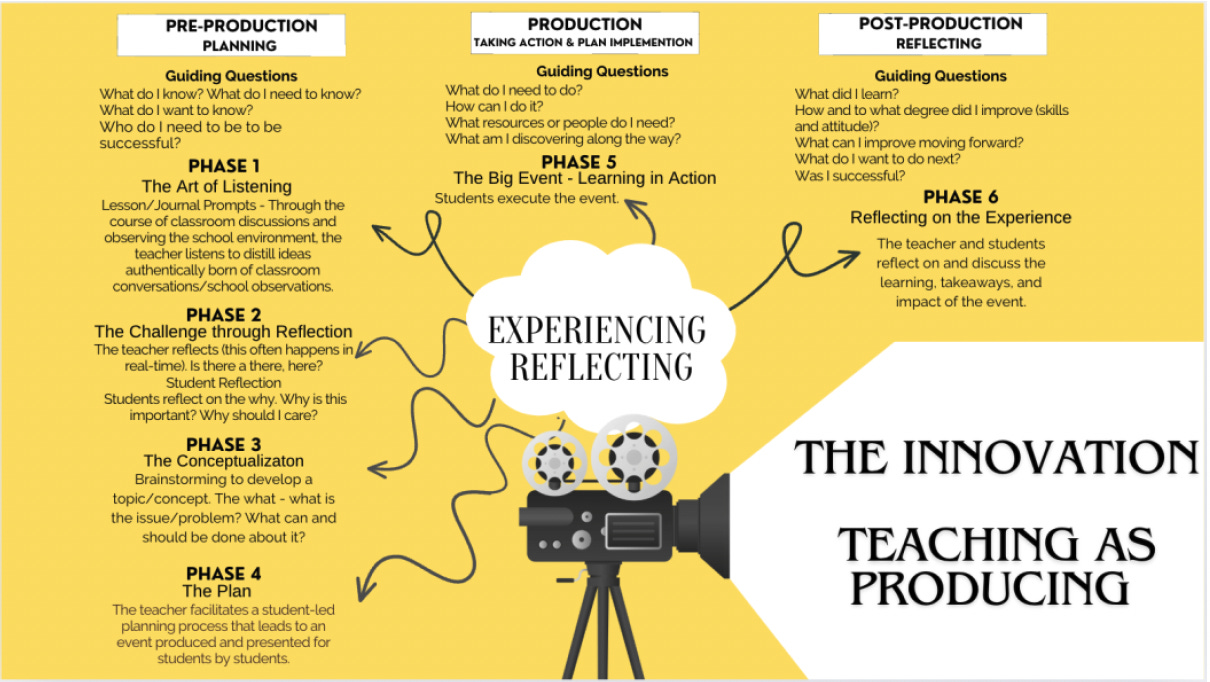
What matters is not the “event” itself, but the learning embedded in the process: communication, collaboration, creativity, critical thinking, leadership, and problem-solving—skills students actually need beyond school.
What She Did: Real Work, Real Stakes, Real School
Carleen studied TAP in a public school in Colorado. She and her students co-planned and co-produced a schoolwide Asian American and Pacific Islander (AAPI) Month assembly and festival.
Students took on authentic production roles—writers, hosts, coordinators, designers, cultural researchers, and stage managers. Together, they planned a live, timed event that would be experienced by their peers and school community.
This wasn’t extra credit.
It wasn’t a “fun Friday.”
It was the curriculum.
Through surveys, focus groups, observations, and reflective artifacts, Carleen documented how students experienced TAP—and what changed as a result.
Students reported:
Higher engagement, especially compared to traditional instruction
A stronger sense of agency—feeling trusted to lead and create
Increased belonging and cultural pride, particularly for students whose identities were centered in the event
Greater confidence in using their voices publicly and collaboratively
Students described the work as meaningful because it mattered to others, not just because it earned a grade. The stakes were social, emotional, and communal—not just academic.
They were powerful educational experiences; experiences that will live on, shaping how students see themselves as capable actors in their schools and communities.
Why This Matters Now
At a time when schools are grappling with disengagement, anxiety, and a widening gap between learning and real life, Carleen’s work offers a hopeful, concrete alternative.
Teaching as Producing shows what becomes possible when:
Teachers are trusted as creative professionals
Students are treated as contributors, not consumers
Learning is tied to real work with real consequences
This is not about adding more to teachers’ plates. It’s about reframing what they already do—and recognizing that classrooms, like productions, are collaborative, dynamic, and deeply human.
Dr. Carleen Brown didn’t just write a brilliant dissertation.
She named a practice many educators are already inching toward—and gave it a framework, a language, and evidence of its impact.
And in doing so, she reminds us:
Sometimes the most powerful learning happens when the curtain goes up and the students take the stage.
References
Brown, C. (2024). Teaching as Producing: Using School-Based Events to Foster Student Engagement and Agency. ProQuest Dissertations & Theses.
Weinberg, A. E., Jordan, M. E., & Jongewaard, R. (2024). “Real Work, Real Consequences”: an action-oriented pedagogies (AOP) framework for sustainability education in K-12 classrooms. Sustainability Science, 19(6), 2027-2040.
 | A guest post by
|
Wonderful and insightful piece thank you