

Mapping Climate Education’s Digital Landscape: What We Learned from Educators and Youth (Preliminary Findings)


“Most of my education about climate has been online.”
This statement from a youth participant in our study captures a growing reality: for many young people, TikTok videos, YouTube explainers, and Instagram infographics form the core of their climate learning ecosystem – not classrooms.
Recognizing this shift, our team at Arizona State University launched Empowering Youth Climate Action (EYCA), a multi-year research project funded by the Underwriters Laboratories Research Institutes (ULRI), to understand how youth and educators navigate digital spaces for climate education – and how these spaces might better support action, equity, and relational learning. Broadly, EYCA aims to understand how young people and educators use digital resources for climate learning, and ultimately help reimagine those spaces so they don’t just transmit information but support meaningful, Action-Oriented Pedagogies (AOP). AOP is a framework to support knowledge-building through real world action, engaging students across cognitive (knowledge), affective (emotions and values), and behavioral (actions) domains.
At the 2024 NAAEE Research Symposium, we shared our preliminary findings from Phase 1, which brought together a global survey of teachers and youth – 188 participants across 11 countries – and six focus groups that dug deeper into their experiences with digital climate learning. Phase 1 focused on mapping the digital landscape: where youth and educators go for climate information, what they find, what they do with it, and what’s missing. As climate impacts intensify and as the digital world becomes more deeply woven into everyday life (McCowan, 2025), these questions are no longer peripheral—they’re central to how the next generation understands and responds to planetary challenges.
Here are the preliminary findings that stood out.
1. Youth and educators are finding digital resources through online searches and social media
Across all groups, online searches and social media were the dominant pathways to digital resources for climate education. Youth ages 13–17 leaned especially heavily on social media, especially TikTok, Instagram, and YouTube.
“I would say social media is a big thing. I get a lot of the initial information from social media” – Anaya (pseudonymous), Youth.
Formal educators, for their part, also found resources through professional development, conferences, and their colleagues.
“I go to a lot of PDs about climate and sustainability… I get a lot of resources from those places” – Harper (pseudonym), Educator.
Understanding how these different groups discover online resources can help us better strategize how to share and promote quality resources for effective climate learning.
2. Use of digital resources for climate learning is consistent and key
40% of participants told us they use digital climate resources weekly, and 29% use them daily. Digital platforms aren’t supplemental – they’re central in climate education, especially for youth.
3. Science dominates
The digital climate ecosystem spans numerous subjects – science, geography, computer science, health/PE, career and technical education, and more – but science overshadows everything else, particularly among formal educators. Surprisingly, civics appeared less frequently as a subject in which these resources are used, despite its importance for meaningful participation in climate solutions.
This suggests that digital resources are being framed primarily as scientific or technical tools – not as pathways to civic engagement or social action. There’s huge room for growth here.
4. Justice is an afterthought
Most commonly accessed topics were climate science, climate impacts, human contributions to climate change, and adaptation/mitigation. More justice-oriented topics – like climate justice, policy, pedagogical frameworks for climate action, social dynamics, and relational values – are accessed less frequently despite their importance. Young people noticed the gap:
“It helps me grow in knowledge… but it doesn’t help me actually connect it to things happening in the real world” – Leila (pseudonym), Youth.
There’s information everywhere. What’s missing is groundedness.
5. Barriers are real: Paywalls, bad design, and irrelevance
Participants flagged predictable frustrations – paywalls, required sign-ups that take too much time, distracting ads – but contextual irrelevance surfaced as one of the most deeply felt obstacles for engaging with digital resources for climate education.
“Some tools aren’t applicable to American Samoa at all… We need our own tools where teachers can use things that apply to our context” – Nora (pseudonym), Educator.
A “global” resource that doesn’t speak to local realities often fails before it begins.
6. What makes a digital resource for climate learning high-quality?
Across groups, participants looked for: Credible institutions; clear, appealing visuals; interactivity; real-life examples; emotional resonance; and local relevance.
Quality isn’t just accuracy. It’s connection.
7. What’s missing: Diversity, justice, and a sense of belonging to the more-than-human world
Three absences surfaced numerous times:
Diverse perspectives, especially Indigenous, local, and community knowledge
Equity and justice woven into the core, not as “add-ons”
Humans as part of nature, rather than managers or problem-solvers standing outside it
The digital landscape is rich in facts but still thin in relationality.
Where We’re Heading Next
Through this project, our ultimate goal is to imagine and design digital spaces that cultivate agency, belonging, and collective action. Phase II, which has already started, brings educators and youth into co-design processes to test and re-build these digital spaces together.
Digital platforms are shaping how we understand climate change and how we imagine the future. But the ecosystem we have now is uneven: rich in information, thin in relationality; heavy on facts, light on justice; global in reach but not in contextual relevance; informative yet not always empowering.
Our research points to both the promise and the gaps, and underscores the need for climate learning spaces rooted in community knowledge, equity and justice, and relational understandings of human–nature interdependence.
We’re excited to continue building toward that digital ecosystem, one that doesn’t just teach climate content but supports young people and educators in imagining and enacting more just and livable futures.
References
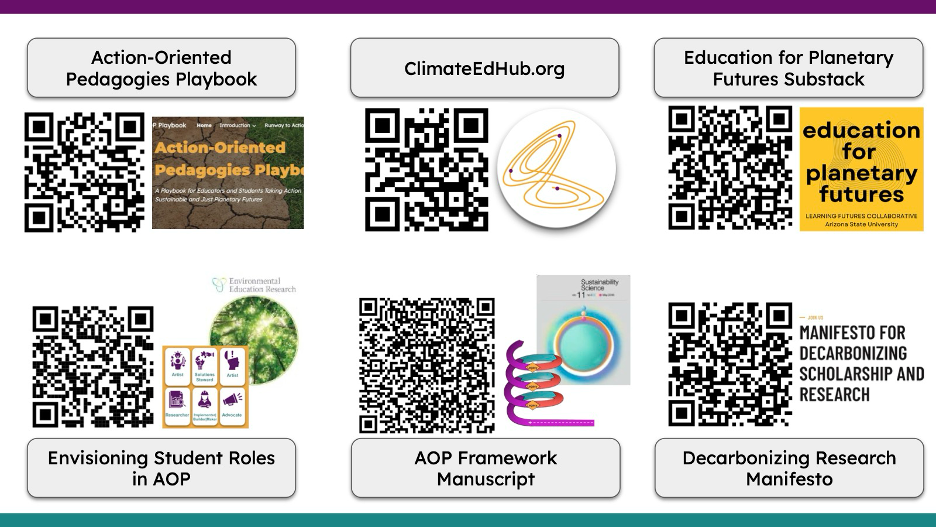
ClimateEd Hub. (n.d.). ClimateEd Hub — Helping educators bridge climate & sustainability education with real-world action. https://climateedhub.org
McCowan, T. (2025). Universities and climate action. UCL Press.
Weinberg, A.E., Jordan, M.E. & Jongewaard, R. (2024). “Real Work, Real Consequences”: An action-oriented pedagogies (AOP) framework for sustainability education in K-12 classrooms. Sustain Sci19, 2027–2040. https://doi.org/10.1007/s11625-024-01560-z
EYCA Project Team: Andrea Weinberg, Iveta Silova, Michelle Jordan, Rajul Pandya, Victoria Desimoni, and Sarah Suloff.
 |
|